Social robot · 2025
Supporting university students with learning difficulties by co-designing a social robot companion
From field observations to co-design workshops: Developing an empathetic, non-judgmental study companion
"Focus Mode & Anxiety Scaffolding"
PARTICIPATORY DESIGN & QUALITATIVE INQUIRY · UNIVERSITY OF TRENTO (2025)
CORE PROJECT HIGHLIGHTS & SHIFT
32+ Students
Total Participants
QRM → PD
Methodology Funnel
Digital Companion
Final Outcome
Problem Framing & Research Scope
"Designing a non-judgmental social robot companion that scaffolds university students facing executive function hurdles and study anxiety—without introducing stigma or surveillance dread."
Multi-Stage Discovery Funnel
Ethnographic Fieldwork
Naturalistic study habits & ADHD distraction patterns.
Thematic Coding
Open & axial coding on raw field notes.
Deep Interviews
N = 10 · 45-min qualitative sessions on coping mechanisms.
Co-Design Workshops
2 iterative sessions · N = 32 students using Dixit & prioritization matrices.
VALIDATED PROBLEM CLUSTERS (QRM DATA CODING)
Synthesized direct inputs for Participatory DesignExecutive Planning & Structure
- •Planning breakdowns & schedule paralysis
- •Inability to micro-chunk syllabus volume
- •Break control failures (5-min turning into doomscrolling)
Emotional Friction & Paralysis
- •Exam dread & academic overwhelm
- •Procrastination loops & guilt avoidance
- •Fear of falling behind peers & solo-study isolation
Cognitive Retention & Focus
- •Involuntary focus drops & attention drifting
- •Cognitive fatigue during passive reading
- •Scattered multi-source study materials
Participatory Design Workshops & Tangible Mediators
To translate qualitative findings into concrete system features, we conducted two iterative co-design workshops. We designed tangible boundary objects—surfacing unspoken emotional experiences through metaphorical Dixit cards and consensus prioritization matrices:
In-Class HCI Peer Session
Facilitated with 24 Master's students in HCI. Revealed that formal university classroom environments induce subtle academic hierarchy and evaluative anxiety, constraining raw emotional vulnerability. Enabled calibration of session timing and card prompts.
Off-Campus Safe Space Session
Relocated into a neutral, relaxed living lounge at the Sanbapolis university dormitory. Dissolving institutional power structures fostered deep psychological safety, allowing students to openly discuss personal coping secrets and academic shame.
Boundary Objects & Situated Reflection
Tangible artifacts—such as metaphorical Dixit cards and sorting matrices—serve as shared communicative bridges across diverse participants, externalizing tacit emotions without clinical stigma.
(Ref: Star & Griesemer, 1989; Schön, 2017)Psychological Safety in Co-Design
A non-judgmental co-creation space is essential when discussing neurodiverse vulnerabilities and study anxiety; participants only disclose genuine habits when fear of peer judgment is removed.
(Ref: Edmondson, 1999; Cornwall, 2008)CO-DESIGN WORKSHOP · PARTICIPATORY RESEARCH & SYNTHESIS
Generative Research: Tangible Metaphors (Dixit Cards)
STORYTELLING & CLUSTERING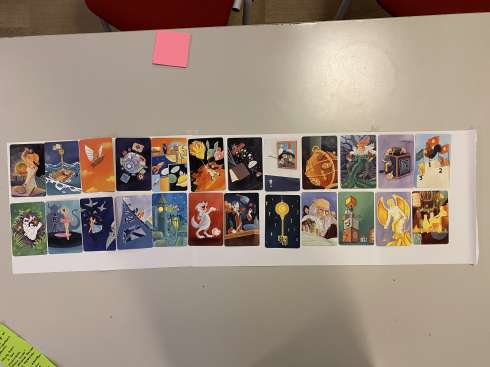
Table A · Metaphorical Storytelling
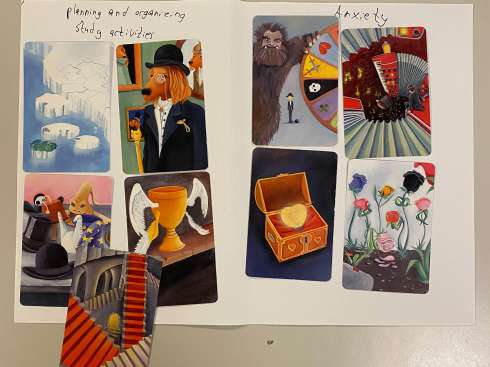
Table B · Thematic Clustering
We used Dixit cards as tangible mediators to help students project and articulate abstract emotional hurdles during study marathons.
Key Takeaway: The primary source of dread wasn't poor scheduling, but cognitive overload and fear of losing control over the learning flow.
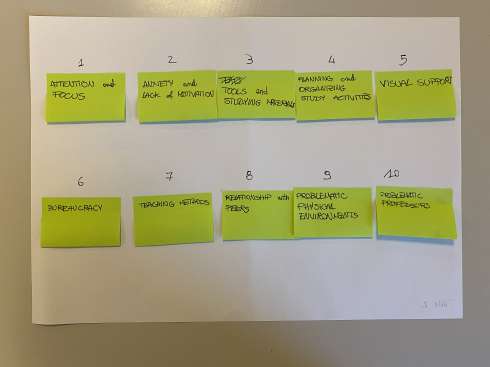
Immediate ambient focus cues: gentle reminders without loud, intrusive shame notifications.
Emotional anxiety scaffolding: validating effort rather than merely tracking score metrics.
Rigid surveillance lockouts: rejected as counterproductive and anxiety-inducing.
From Synthesis to Product Pillars
Synthesizing co-design insights into three foundational pillars that bridge user anxiety with ergonomic interaction patterns.
Adaptive Customization
Breaks syllabi into flexible micro-sessions. Dynamic pacing replaces rigid 25-minute Pomodoro timers to avoid cognitive fatigue.
Low-Anxiety Gamification
Focuses on positive visual progression and non-punitive streaks. Explicitly eliminates shame notifications, guilt screens, and competitive ranking.
Autonomous Agency ("Rubber Duck")
A reflective companion prompting self-articulation ("Where did you get stuck?") rather than solving exercises for the user, preserving agency.
The Strategic Pivot: Rejecting the Physical Robot
Formulated concrete system specifications for a unified student platform integrating task planning, adaptive Pomodoro intervals, and non-evaluative emotional reassurance. Proved the value of bridging Qualitative Research with Participatory Design, demonstrating how tangible boundary objects (Dixit cards) empower neurodiverse students to co-create their own assistive tools.
THE USER-LED STRATEGIC PIVOT (RECRUITER GOLD):
The most decisive empirical finding of the entire co-design process was that students unanimously rejected a physical humanoid robot. Instead of accepting the speculative premise, participants demonstrated sharp pragmatic judgment:
Placing a physical robot on a library desk publicly labels a student as having "special learning difficulties".
Carrying yet another fragile, battery-dependent physical machine in backpacks adds daily friction.
Physical robotics represent high manufacturing costs inaccessible to standard student budgets.
Students already interact with laptops and smartphones where study materials live.
Participants redirected the concept toward an integrated cross-platform digital ecosystem (desktop widget + smartphone app) with an optional subtle ambient physical desk node (such as an ambient status token or tactile dial).
Relational Companionship vs Mechanical Utility
Companionship thrives when interaction is lightweight, non-judgmental, and integrated into existing workflows—acting as a trusted peer rather than an intrusive surveillance overseer.
(Ref: Cazacu et al., 2025; Turkle, 2011)All focus metrics and session logs remain strictly local on the student's hardware. Absolute zero diagnostic data shared with university administration or grading portals.
No ambient microphone listening or camera gaze tracking in student living quarters. Positioned ethically as a supportive study coach, with clear boundaries avoiding clinical diagnostic claims.
KEY DELIVERABLES & ARTIFACTS:
- ✓Ethnographic Field Observations & Thematic Coding
- ✓Semi-Structured Interviews (N = 10) & Focus Group
- ✓Two Iterative Co-Design Workshops (In-Class & Off-Campus)
- ✓Dixit Card Storytelling & Priority Sorting Artifacts
- ✓Final Companion Architecture & Privacy Specifications
- ✓Academic Research Report (University of Trento, 2025)