Tik Tok vs IG · 2026
An UX analysis of In-Feed Advertising on the Pragmatic and Hedonic UX of TikTok and Instagram Reels
The Price of Scrolling: Evaluating how sponsored content impacts immersion, usability, and user retention
COGNITIVE ERGONOMICS RESEARCH · UNIVERSITY OF TRENTO (2026)
CORE PROJECT HIGHLIGHTS & SHIFT
N = 20
Study Sample
UEQ+ Modular
Evaluation Model
Speed vs Layout
Key Trade-Off
The Problem: When Ads Break User Immersion
Short-video feeds rely on immersive 'flow' to keep users engaged. As platforms ramp up ad frequency (reaching 1.7B+ users on Instagram and 1.5B+ on TikTok), commercial interruptions collide with user goals. The research objective was understanding whether interface speed (TikTok) or visual polish (Reels) can protect the user experience from ad fatigue.
Research Background · Cognitive Ergonomics:
Conceived, researched, and authored solely by Gabriele Garzia at the University of Trento (Department of Psychology and Cognitive Science). The goal: investigate how aggressive feed monetization impacts user retention, flow disruption, and perceived app utility across the two leading short-video platforms.
The Flow Experience
A state of immersion where users lose sense of time. Ads directly break this cognitive loop, causing frustration.
(Ref: Zeng, 2023)Cognitive Intrusiveness
When an advertisement interrupts a user's active goal, provoking irritation and an automatic reflex to skip or close content.
(Ref: Li et al., 2002)Research Setup: Usability Testing in the Wild
Executed an unmoderated within-subject experiment with 20 young adults (ages 20–33) on personal mobile devices. Participants completed counterbalanced 7-minute scrolling sessions on both platforms simulating everyday relaxation downtime. Measured pragmatic efficiency and hedonic stimulation using the standardized UEQ+ framework, paired with qualitative post-task feedback.
Within-Subject (N = 20)
Every participant tested both TikTok and Reels on their own smartphone, eliminating personal device and habit biases.
Counterbalanced Order
Half started with TikTok and half with Reels, preventing learning curves or fatigue from skewing results.
7-Min Natural Browsing
Simulating standard relaxation downtime. Calibrated from a 5-min pilot test to ensure natural ad encounters without fatigue.
The Modular UEQ+ Framework
A standardized psychometric questionnaire evaluating both pragmatic usability (Efficiency) and hedonic engagement (Stimulation).
(Ref: Schrepp & Thomaschewski, 2023)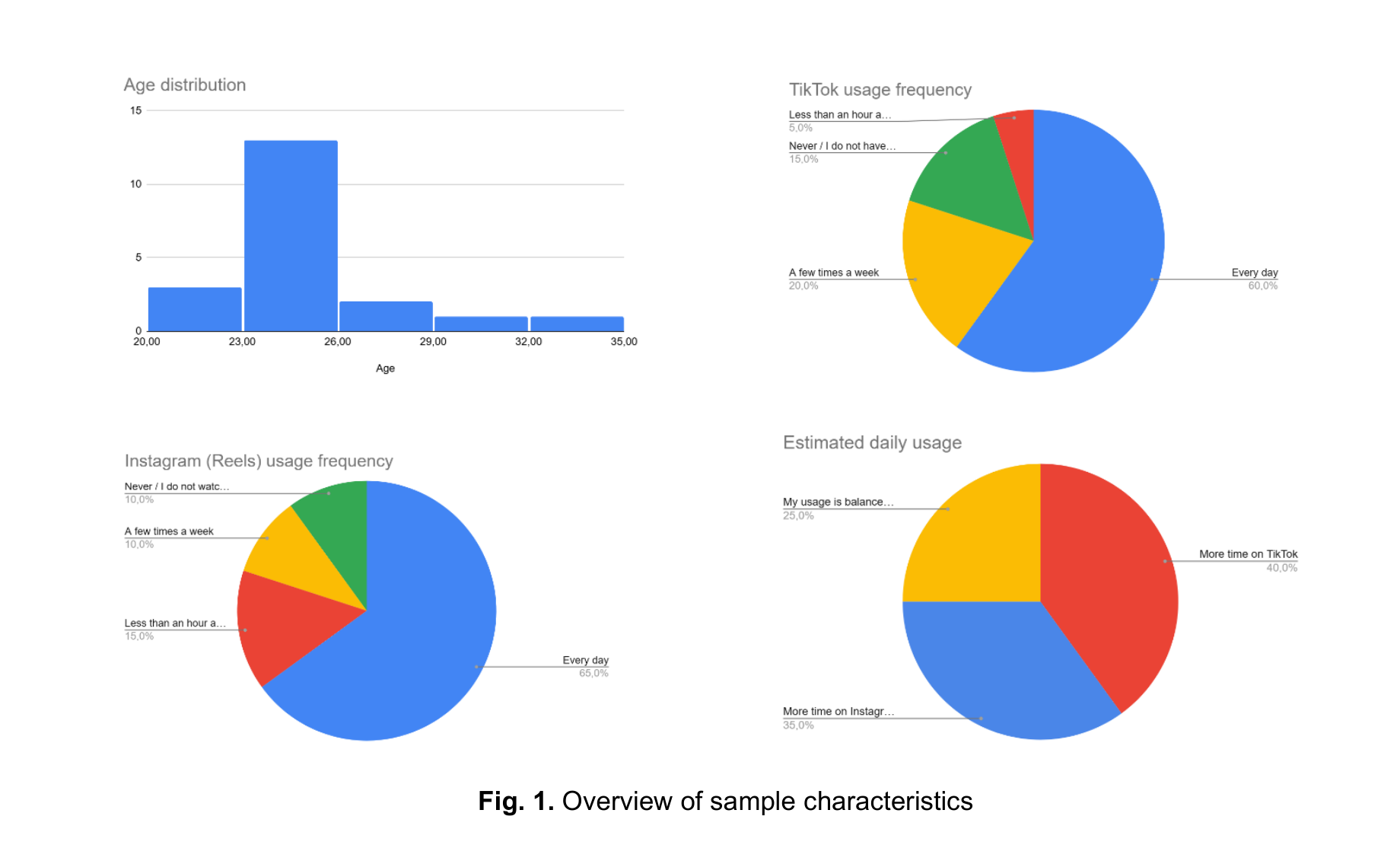
Young adults (predominantly 23–26 years), representing the core demographic of short-video apps.
60% daily active users, with mature algorithm feeds reflecting real personalization.
65% daily active users, reflecting high everyday exposure to Meta's short-video feed.
40% spend more time on TikTok, 35% on Instagram, while 25% balance both equally.
Fig. 1: Overview of sample characteristics and prior platform familiarity. (Ref: Garzia, 2026)
Key Findings: The Speed vs Layout Trade-Off
While macro scores showed both platforms performing decently on the surface, analyzing micro-UX metrics revealed a decisive product divergence:
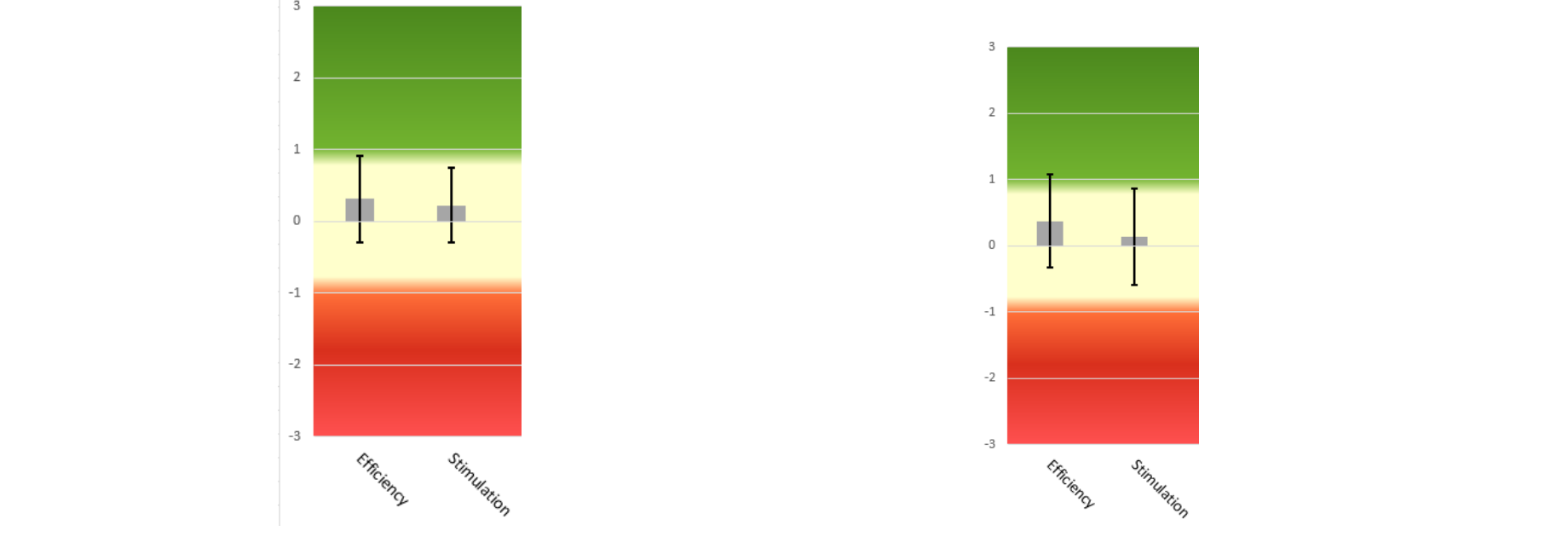
Fig. 2: Modular UEQ+ scale results evaluating in-feed advertising integration on Instagram Reels (left) and TikTok (right). Error bars indicate 95% confidence intervals. (Ref: Garzia, 2026)
HEAD-TO-HEAD UX METRICS BREAKDOWN
TikTok (+1.25) outperforms Instagram Reels (+0.60).
TikTok feels instantaneous and friction-free, preserving scrolling momentum even between videos.
Instagram Reels (+0.70) outperforms TikTok (+0.05).
Reels presents a clean, structured layout, whereas TikTok approaches neutral zero due to visual noise and crowded UI elements.
Instagram Reels (-0.25) drops into negative territory (TikTok: 0.00).
Despite clean layouts, ads on Reels actively hinder navigation and feel like functional roadblocks.
Meta's ads are rated more interesting (+0.80 vs +0.35), yet overall perceived value crashes into the negatives on both: TikTok (-0.35), Instagram (-0.25).
What Users Said: 3 Behavioral Reactions to Ads
Qualitative analysis of user comments revealed a clear preference for TikTok's browsing speed, alongside three distinct coping behaviors when encountering ads:
"Advertisements on both social media platforms bother me. The ones on Instagram feel more intrusive, but at the same time more structured."
Most users actively resent interruptions during immersive browsing. Instagram ads are noticed more and feel heavier, despite looking cleaner.
"Honestly, when I notice 'sponsored' I just skip immediately... when they're out of context I find them annoying. I think I've never finished watching an ad reel."
Users develop an automatic skip reflex: the 'sponsored' tag triggers an instant upward swipe. Unless content is hyper-relevant within the first second, completion rates are near zero.
"Not at all."
A small minority displays high cognitive tolerance, treating commercial interruptions as background white noise without conscious annoyance.
Product Takeaways & Actionable Heuristics
Proved that unsolicited commercial interruptions break user flow regardless of design polish: overall interaction value dropped into negative scores on both platforms (-0.35 on TikTok, -0.25 on Reels). Developed evidence-based UX guidelines for balancing ad monetization with user retention.
THE CORE MONETIZATION PARADOX FOR PRODUCT TEAMS:
In-feed ads inherently sabotage the product's primary engagement driver: The Flow State. Neither high operational speed (TikTok) nor visual elegance and ad targeting (Instagram Reels) can prevent commercial interruptions from devaluing how users perceive their time on the app.
Avoid abrupt volume or visual style jumps that jar users out of immersion.
Users skip ads instantly upon spotting 'Sponsored' unless hooks match their immediate interests.
Heavy overlays amplify ad annoyance; clean visual hierarchy mitigates frustration.
KEY DELIVERABLES & ARTIFACTS:
- ✓Within-Subject Usability Testing (N = 20)
- ✓Modular UEQ+ Statistical Synthesis
- ✓Flow Disruption & Intrusiveness Analysis
- ✓Solo Academic Research Paper (University of Trento)